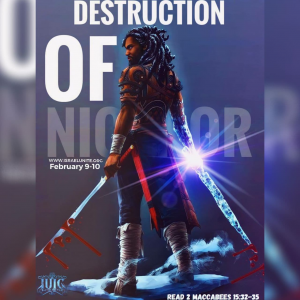
The Destruction of Nicanor is a day recounting the history of Judas Maccabees and his brethren prevailing against Nicanor who tried to destroy Israel’s sanctuary. Alcimus, a wicked Israelite, greatly desired to be set up as high priest over Israel. He was an ungodly and traitorous man to his people and wanted power by any means necessary. This prompted him to go to King Demetrius and make false accusations against Judas (also called Maccabees) and his men. The king made Alcimus high priest and commanded him to take vengeance upon the children of Israel due to the false accusation that Judas and his brethren killed his friends and drove them out of the land. Alcimus did much evil and harm to the Israelites in the land of Judea. This caused Judas and his army of men to defend themselves and take vengeance, eventually getting the upper hand in the battle. When Alcimus saw the uprising against him, he further slandered Judas and his brethren to King Demetrius. The king then commanded Nicanor, one of his honorable princes, to destroy them due to the strong and deadly hate he had towards the Nation of Israel.
Nicanor went to the holy temple that Solomon built and demanded the priests to deliver Judas Maccabees to him. When the priests swore that they did not know where Judas was, Nicanor stretched out his right hand toward the temple and made an oath saying: “If ye will not deliver me Judas as a prisoner, I will lay this temple of God even with the ground, and I will break down the altar, and erect a notable temple unto Bacchus (a Greek God),” II Maccabees 14:33. The day came when Nicanor and his army made war against Israel, having elephants girded for battle and weaponry. Judas led the small army of Israel against them with prayer and slew Nicanor’s incredible host. The Israelites rejoiced in this day with great gladness and praise to the Most High for keeping His temple undefiled. This day, the thirteenth day of the month Adar was ordained to be kept yearly with great celebration.
2 Maccabees 15:
- v36– And they ordained all with a common decree in no case to let that day pass without solemnity, but to celebrate the thirteenth day of the twelfth month, which in the Syrian tongue is called Adar, the day before Mor’decai’s day.
The Day of Nicanor is not stated in the Bible to be kept as a Sabbath like other high holy day celebrations where buying, selling or servile work is not permitted.
Scriptural References
The complete history of Nicanor can be found in the following books and chapters: I Maccabees 7th chapter, II Maccabees 14:3-46, II Maccabees 8:1-36 and II Maccabees 15:1-36
Leviticus 23:
V24- Speak unto the children of Israel, saying, In the seventh month, in the first day of the month, shall ye have a sabbath, a memorial of blowing of trumpets, an holy convocation.
v25- Ye shall do no servile work therein: but ye shall offer an offering made by fire unto the LORD.
Numbers 10:1: “ And the LORD spake unto Moses, saying,
2: Make thee two trumpets of silver; of a whole piece shalt thou make them: that thou mayest use them for the calling of the assembly, and for the journeying of the camps.”
3: ”And when they shall blow with them, all the assembly shall assemble themselves to thee at the door of the tabernacle of the congregation.”
4: ”And if they blow but with one trumpet, then the princes, which are heads of the thousands of Israel, shall gather themselves unto thee.”
5: ”When ye blow an alarm, then the camps that lie on the east parts shall go forward.”
6: ”When ye blow an alarm the second time, then the camps that lie on the south side shall take their journey: they shall blow an alarm for their journeys.”
7: ”But when the congregation is to be gathered together, ye shall blow, but ye shall not sound an alarm.”
8: ”And the sons of Aaron, the priests, shall blow with the trumpets; and they shall be to you for an ordinance for ever throughout your generations.”
9: ”And if ye go to war in your land against the enemy that oppresseth you, then ye shall blow an alarm with the trumpets; and ye shall be remembered before the LORD your God, and ye shall be saved from your enemies.”
10: ”Also in the day of your gladness, and in your solemn days, and in the beginnings of your months, ye shall blow with the trumpets over your burnt offerings, and over the sacrifices of your peace offerings; that they may be to you for a memorial before your God: I am the LORD your God.”